

Managed Legacy Service: understand your legacy system before you decide
A lack of transparency makes every change harder. We analyse your legacy system and give you a sound basis for decisions.
Most legacy systems have done their job reliably for years. Their real condition only shows when something new is required: a new interface, a security patch, a migration decision or an AI use case on existing data. We help you understand your system, run it reliably and modernise it step by step.
- Assessment and basis for decisions
- Stabilisation and operations
- Migration and technical renewal
As long as nothing in the system changes, everything runs. That is exactly the problem.
As soon as a change is due, the gaps become visible:
- The documentation is incomplete.
- Key dependencies can no longer be traced.
- Knowledge sits with a few people who are tied up in daily business or left the company long ago.
- A small change turns into a risk analysis, a planned migration into a black box.
At the same time, requirements for security, availability and traceability keep rising, even if the system was never designed for them. You are expected to assess effort, risks and options for management, audit or business units without the basis to do so. Decisions get postponed or rest on assumptions. Both are expensive.
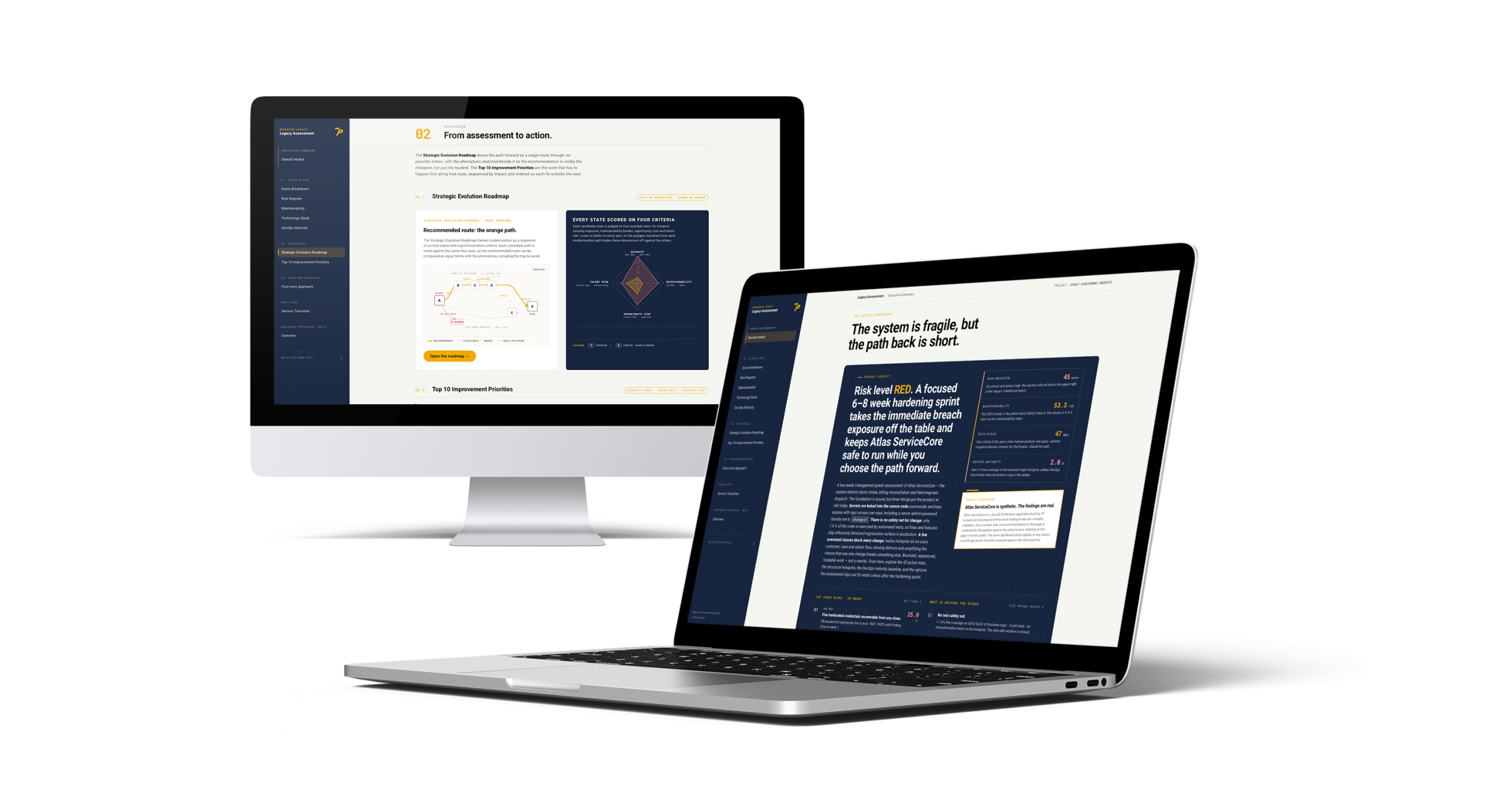
Legacy Fast Check: what our legacy system analysis delivers
What does the result of an analysis look like? An anonymised report from a completed project shows it: a structured assessment overview, a complete risk catalogue and a weighted action roadmap. Afterwards, the existing system is fully documented.
You will find the results report in our resources, and more Fast Checks from practice underReferences.
Assessment and basis for decisions
Still open how the system should evolve? The right next step depends on how well structure, dependencies and risks are understood. This step makes sense if
- you need to decide on migration or replacement but cannot reliably estimate effort and risks,
- changes are possible but their impact is hard to predict,
- knowledge of the architecture and dependencies is incomplete or scattered,
- you need a sound basis for management or business units.
Legacy Fast Check
Analyses the system and makes structure, interfaces and dependencies traceable. Shows risks in operation and maintenance, estimates the effort for changes or migrations and compares realistic options. Result: a decision paper for management and planning.
Legacy GenAI Quick Call
Assesses where AI makes sense in the specific system: possible use cases, suitability of data and structure, support for analysis, documentation or further development. We clearly rule out unrealistic expectations.
Legacy Process Analysis
Reconstructs business processes from system logic and data flows, shows dependencies between processes and components and makes visible which workflows a change affects. The basis for targeted adjustments or replacements.

Stabilisation and operations
The system stays in use but causes more and more effort? Then day-to-day operations must remain reliably manageable. This is the case when operations tie up a lot of resources, incidents keep recurring, maintenance depends on individual people or your team has hardly any time for further development.
Legacy Guard
Stabilises operations: we take over maintenance and bug fixing, analyse incidents in a structured way instead of only reactively, improve stability in a targeted way and address known weaknesses by priority.
Legacy Full Auto
We take full responsibility for operation, maintenance and further development, implement changes in a controlled way and relieve your teams. This frees up capacity for new projects.
Migration and technical renewal
When infrastructure or architecture becomes the limiting factor, you need a practical modernisation path. Typical triggers: a planned migration without assessed risks, technologies without support, new requirements the architecture can barely support, complex integration with other systems.
Legacy Modernization
Adapts architecture and code in a targeted way: we determine what can be kept, remove technical constraints and improve maintainability and extensibility. Step-by-step adaptation instead of a complete rebuild.
Legacy Lift & Shift
Moves applications to cloud or new operating environments, keeps the business logic with minimal changes to the code and improves scalability and operating options.
Legacy AI Retrofit
Makes data from the system available for new applications, adds interfaces to modern architectures and lays the foundation for automation and AI-supported analysis.
AI in legacy management
AI helps you understand existing systems faster. It does not replace the decision on how to deal with them.
Where exactly do you use AI?
When evaluating code, documentation and data structures in systems that have grown over time: analysing technical dependencies, creating and maintaining documentation, evaluating existing data, preparing changes or migrations and generating test cases.
What changes with AI?
Above all speed and traceability: dependencies become visible faster, documentation becomes more consistent, analysis effort decreases and existing knowledge becomes easier to use.
What stays the same?
In business-critical systems, key decisions remain driven by domain expertise. Architecture decisions are not automated, security and compliance continue to be reviewed, and responsibility for changes stays with the project team.
How does 7P use AI?
In a targeted way and embedded in existing processes: results are reviewed and assessed by experts, and use follows defined quality and approval steps as well as your governance and security requirements.

Start with a sound assessment of your system
The Legacy Fast Check gives you a sound basis for decisions in a short time. Your contact is Sebastian Grundhöfer, Team Manager at 7P.
Talk to us about your legacy system
Assessment, stable operations or modernisation: together we find the right starting point.